
One design change made this coin instantly recognizable.
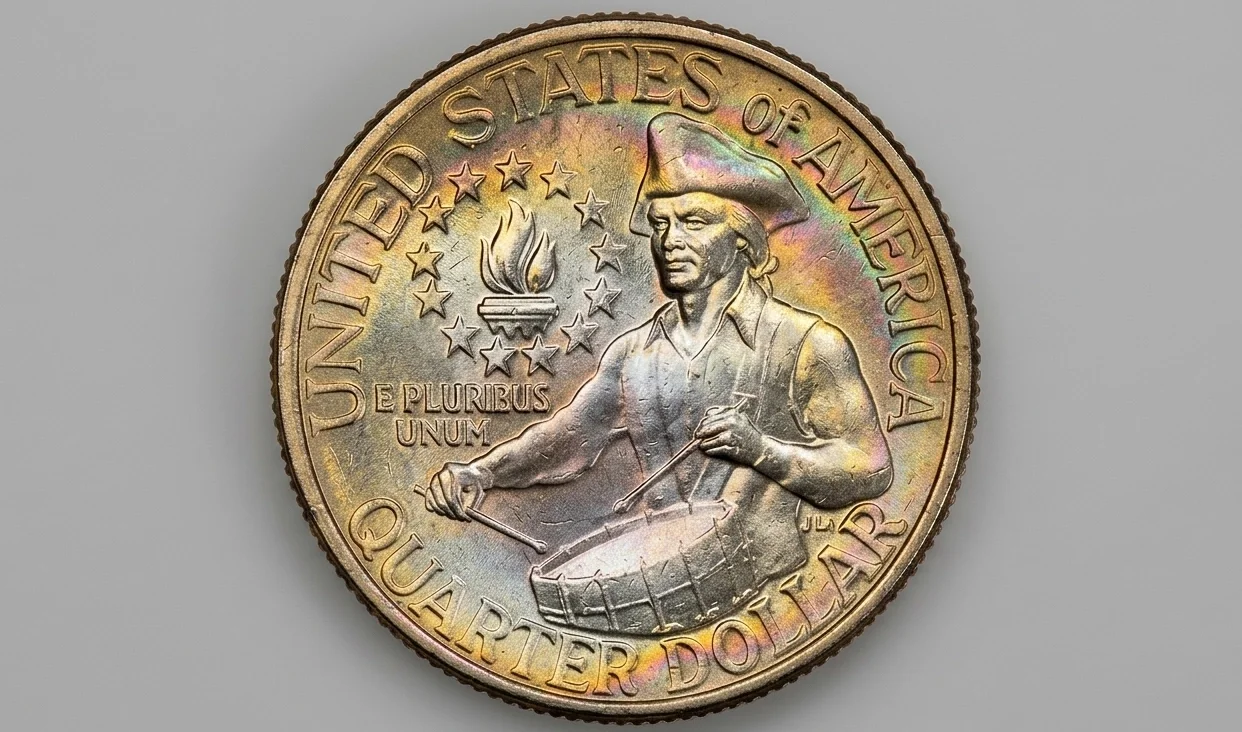
Issuing a commemorative 1976 Bicentennial Quarter for the 200th anniversary of US independence marked the first temporary design change of a circulating reverse in national history.
Design Selection and Historical Context
Selecting sketches involved an open nationwide competition.
Judges reviewed over 800 entries submitted by professional artists and amateurs.
Jack Lühr won the quarter category, proposing the colonial drummer image.
Thirteen stars surrounding a victory torch complete the design.
Thirteen stars → Representing the original colonies forming the union.
Lühr’s artwork replaced John Flanagan’s standard reverse during the 1975–1976 period.
Missing 1975 dates on quarters result from the Mint's decision to strike the Bicentennial version for two consecutive years.
Copper-Nickel Version: 75% Copper and 25% Nickel cladding on a 100% Copper core.
Silver Version: 80% Silver and 20% Copper cladding on a core containing 21% Silver and 79% Copper.
Metric | Copper-Nickel Variant | Silver Variant |
Total Silver Content | 0.000 | 400 |
Item Mass | 5.67 grams | 5.75 grams |
Thickness | 1.75 mm | 1.75 mm |
Edge Type | Reeded | Reeded |
A mass difference of 0.08 grams serves as the primary factor when identifying metal types.
Using high-precision scales allows for distinguishing Silver quarters from clad ones without chemical testing.
Mintage Analysis by Mint Locations
Facilities in Philadelphia, Denver, and San Francisco operated at peak capacity meeting public demand.
Total production volume exceeded 1.6 billion specimens.
Mintage distribution by location:
Philadelphia (No mint mark): 809,784,016 units
Denver (D mark): 860,118,839 units
San Francisco (S mark, Copper-Nickel Proof): 7,053,992 units
San Francisco (S mark, Silver Proof): 4,000,000 units
San Francisco (S mark, Silver Uncirculated): 11,000,000 units
Total Copper-Nickel circulation volume → 1,669,902,855 units.
Huge mintage figures cause low values for common specimens found in circulation.
Primary value in 2026 remains concentrated in coins preserving original mint luster without contact marks.
Auction Records
Value for 1976 quarters depends heavily on professional grading.
Objective data from Heritage and Stack's Bowers auctions shows rising prices for rare conditions.
Price Stats for Copper-Nickel Coins (Denver):
Grade MS65: $15
Grade MS67: $450
Grade MS68: $3,200
Record Price: $6,463
Price growth for MS68 specimens reached 42% over the last decade.
Price Stats for Silver Coins (San Francisco):
Grade MS67: $25
Grade MS68: $95
Grade MS69: $2,800
Record Price: $19,200
Investment appeal increases significantly upon reaching the MS68 threshold.
Coins in MS64 condition or lower trade near metal value or face value.
Rare Varieties and Minting Errors
Searching for specific manufacturing defects remains a priority for specialists.
Errors occurring during production increase market prices dozens of times over.
Key types of collectible deviations:
Doubled Die Obverse: Noticeable doubling of the "LIBERTY" inscription
Missing Mint Mark on Proofs: Technical failure
Struck on Wrong Planchet: Extremely rare occurrences
Die Cracks: Creating unique relief patterns on the surface
Claiming a Silver quarter exists without an "S" mark is a myth unsupported by official registries.
Every suspicious specimen requires certification through professional services like PCGS or NGC.
Lacking a certificate reduces buyer trust by 70-80%.
Silver Content and Patina Analysis
Silver alloys with 400 purity were used exclusively for commemorative sets.
These coins never entered daily payment cycles.
Silver aging process → Forming unique patina.
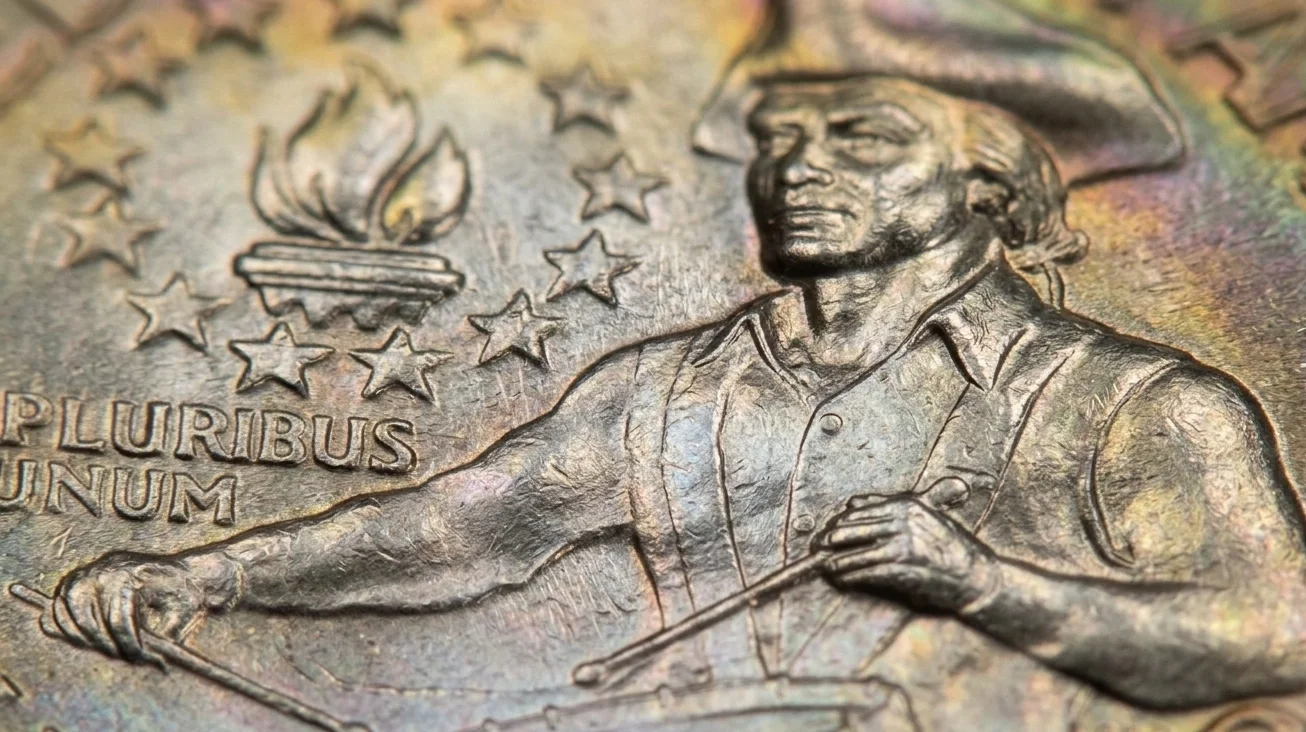
Rainbow toning can add between $50 and $500 to the coin's value depending on intensity.
Pure Metal Parameters:
Pure Silver per coin: 2.3 grams
Metal price vs. MS69 numismatic grade price: 1 to 120
Falling precious metal prices on the stock exchange weakly affect top-tier grade pricing.
Numismatic rarity dominates material value.
Grading Procedures in 2026
Professional evaluation in 2026 relies on strict preservation standards.
The Free Coin Scanner App surface analysis algorithms identify microscopic scratches invisible to the naked eye.
Quality Criteria for the 1976 Series:
Washington's hair lines: Sharpness of the strands
Drum details on the reverse: Visibility of all tension strings
Field cleanliness: Absence of "bag marks"
Original mint luster: "Cartwheel" effect
Circulated specimens → Lost relief details → Good or Very Fine grades.
Coins from bank rolls → Potential candidates for Mint State.
Finding an MS68 in a regular roll happens roughly 1 in 100,000 times.
Cultural Impact and Design Legacy
Jack Lühr’s design is recognized as one of the most successful in US quarter history.
Visual dynamics of the drummer figure distinguish the coin from static heraldic eagles.
Bicentennial symbolism encouraged massive hoarding by the general public.
This fact led to an artificial shortage of high-quality specimens in the long run.
Most hoarded coins were stored in substandard conditions.
Oxidation and corrosion → Reducing value to face value.
Proper storage in inert capsules prevents metal degradation.
Legal and Financial Ownership Aspects
The 1976 quarter remains legal tender across the United States.
Face value is $0.25.
Retailers accept these coins at face value without considering collectible premiums.
Bank deposits take quarters in standard $10 wrappers.
Investors prefer working with assets having confirmed auction provenance.
Risks of Owning Uncertified Coins:
Difficulty selling at market price
Potential for buying coins with restored surfaces
Mistaking Copper-Nickel versions for Silver
Utilizing digital catalogs and sold lot databases minimizes risks.
Self-Verification Instructions
Discovering a 1976 quarter at home requires conducting several tests and using the best coin identifier app.
First step: Inspect the mint mark under Washington’s portrait.
"D" mark → Denver. "S" mark → San Francisco. No mark → Philadelphia.
Second step: Check the edge color.
Copper stripe on the edge → Clad Copper-Nickel coin.
Solid gray color → Reason for weighing to check Silver composition.
Third step: Evaluate overall luster.
Dull gray surfaces often indicate time spent in soil or long-term circulation.
Cleaning coins with abrasive substances destroys numismatic value entirely.
Prohibited Actions:
Using baking soda or toothpaste
Wiping with coarse cloth
Storing in PVC albums
PVC releases gases → Damaging surfaces through chemical reactions.
Collection Set Packaging Specifics
The US Mint released 1976 quarters in special envelopes and cases.
Blue envelopes → Uncirculated sets (Silver).
Red envelopes → Proof sets (Silver).
Original packaging condition affects the set's price as a single lot.
Opening sealed plastic holders can lead to moisture exposure.
Professional dealers value the integrity of factory sets.
Individual grading of each coin from a set is justified only if no visual defects exist.
